OUR GLOBAL MOVEMENT




Corruption in the defence and security sector plays a critical role in driving instances of armed conflict and violence, while also contributing to the erosion of democratic norms and institutions.
Nowhere are the consequences of this corruption felt more acutely than by people living in fragile and conflict affected areas.
Bringing insights from Transparency International Chapters in Niger, Nigeria and Tunisia, the latest webinar from Transparency International Defence and Security explores how to best leverage evidence from Transparency International Defence and Security’s flagship Government Defence Integrity Index (GDI) – the world’s leading assessment of corruption risks in defence establishments – to strengthen institutional resilience to corruption risks.
Our expert panel will unpack how systemic weaknesses in governance and transparency exacerbate security challenges and economic fragility across three case studies, drawing on the finding summarised in newly published policy briefs.
Shérif Issoufou Souley, Projects and Programs Manager·Association nigérienne de lutte contre la corruption (ANLC)
Abubakar Jimoh, Head of Communications·Civil Society Legislative Advocacy Centre (CISLAC)
Siwar Gmati, Monitoring and Evaluation Manager & Fundraising Coordinator·iWatch
Francesca Grandi, Senior Advocacy Expert, Transparency International Defence & Security (Moderator)
Launching their latest report Unlocking Access: Balancing National Security and Transparency in Defence, the webinar will examine global practices of access to information, identify critical barriers to transparency, and provide actionable recommendations to mitigate corruption risks in defence sectors worldwide, as well as suggest ways to overcome the misuse of national security limiting public oversight.
We will explore practical strategies to balance the need for security with the public’s right to information and learn how to strengthen transparency in one of the most sensitive government sectors. Following a discussion on how robust public interest tests and independent oversight mechanisms can enhance transparency and accountability, we will share insights from case studies from Armenia, Malaysia, and Tunisia, highlighting varying transparency levels and common challenges.
Our expert panel brings together specialists on access to information, transparency advocates, and key contributors to the report.
Date: Thursday 19 September
Time: 09:00 EDT
Location: Millennium Hilton New York, One UN Plaza, New York
Corruption is a driver, root cause and consequence of armed conflict, violence and insecurity. Cross-cutting by nature, it impedes investment in and implementation of the entire 2030 Agenda. Strengthening resilience to corruption by improving governance of the public sector can supercharge progress on sustainable peace and development by building trust in public institutions, safeguarding resources, preventing violence and increasing our resilience to threats and shocks.
In recent years, preventing and combatting corruption has moved down the global agenda. Corruption is often seen as a bureaucratic, victimless crime, the fight against which is desirable, but not a priority. This could not be further from the lived experience of those affected by it. Where corruption is linked with violence and insecurity, it becomes something much bigger: a human rights issue, a development issue, and an equality issue.
Multilateral solutions for a better tomorrow must focus on addressing the risk corruption poses to international peace and security. The Summit of the Future is an opportunity to bring good governance back into the spotlight.
Join us on Thursday 19 September, 09:00 EDT to explore the existing gaps in addressing corruption and how we can work together to resolve them. We will discuss how the Pact of the Future can be a vessel for progress to combat corruption as a serious threat to peace and security, human rights, and sustainable development.
Opening remarks:
Panel:
SDG 16 makes a strong case for better alignment of policy and practice between the governance, peace, security, and development communities. But progress has trailed far behind expectation. Although the link between good governance and peace and security is well-recognised, the integration of these agendas is often fragmented.
At a time in which geopolitical tensions, conflict and violence are rising, and democratic governance and human rights are increasingly under pressure, progress on SDG 16 is more vital than ever. This step forward requires the different pillars to be unified, and for a greater focus on prevention in policy and practice, building on the ideas set out by the UN Secretary-General in the New Agenda for Peace.
The review of SDG 16 at the High-Level Political Forum 2024 provides an opportunity to explore how we can advance solutions. Join Transparency International Defence and Security and their expert panel for a virtual side event to discuss:
Sara Bandali, Director of International Engagement, Transparency International UK (Moderator)
Jonathan Bourguignon, Crime Prevention and Criminal Justice Officer, United Nations Office on Drugs and Crime
Vincenza Scherrer, Deputy Head of the Policy and Research Division, DCAF - Geneva Centre for Security Sector Governance
Bertha Ogbimi, Senior Program Officer, Civil Society Legislative Advocacy Centre (CISLAC)
Corruption is a central barrier to building a sustainable, inclusive and prosperous future for all. In the search for a better tomorrow, anti-corruption efforts need to be front and centre of multilateral solutions. However, there is no direct reference to corruption and its devastating impact on international peace and security in the UN’s Pact of the Future.
Join Transparency International Defence and Security on Wednesday 8 May, 15:00 GMT+1 / 17:00 EAT for our webinar ahead of the UN Civil Society Conference in Nairobi. Our session invites anti-corruption champions and peacebuilders from around the world to discuss how the upcoming UN Summit of the Future and its accompanying Pact of the Future can be a pathway to much-needed systemic change on how we view and address corruption in defence and security.
Sharing stories that show how corruption in defence and security impacts on people’s lives from our upcoming report, 'Betrayed by the Guardians: The Human Toll of Corruption in Defence and Security', our webinar will share new examples and perspectives on how corruption threatens international peace and security, and how the upcoming UN processes can accelerate progress to address this important issue.
Jacob Tetteh Ahuno joined Ghana Integrity Initiative, Transparency International's local chapter in Ghana, in 2015 as Programmes Officer
Ikram Afzali leads Integrity Watch, Transparency International's local chapter in Afghanistan
Peggy Chukwuemeka, Executive Director, Parent-Child Intervention (PCIC) Nigeria
Najla Dowson-Zeidan, lead author of the publication
As gender advocates gather at the United Nations for the sixty-eighth session of the Commission on the Status of Women, corruption and conflict are notably absent from the agenda.
Transparency International Defence and Security explored how conflict, insecurity and corruption fuel gender inequality, and what the international community can do to prioritise this cross-cutting concern in the future in the first webinar in their new series.
Gender inequality, corruption and insecurity are part of a vicious cycle. Corruption is shaped by gendered dynamics which often exacerbate insecurity.
At the same time, gender concerns are rarely integrated into anti-corruption measures, and anti-corruption efforts are often missing from high-level discussions about women’s empowerment and gender equality.
Whether we are looking at conflict prevention, conflict response, or peacebuilding processes, integrating gender into anti-corruption measures must become an international priority.
Our expert panel discussed how the absence of corruption and gender considerations feed insecurity in the context of their work, and how they work to fight it.
Join us for the launch of Transparency International Defence & Security’s flagship assessment tool, the Government Defence Integrity Index on Thursday 20 January, 15:30-16:45 GMT
With nearly two-thirds of countries facing a high to critical risk of corruption in their defence and security sectors, Transparency International Defence & Security’s flagship Government Defence Integrity Index has never been more important.
Exploring five key risk areas (financial, operational, personnel, political, and procurement) across 86 countries, the findings bring a specific focus to the role that governments play in ensuring good governance and the need for defence institutions to be resilient to corruption to achieve this.
Building integrity in the defence sector: a framework for better governance on Thursday 20 January, 15:30-16:45 GMT will explore the specific opportunities for civil society engagement with defence sectors in different contexts and ways to push for greater transparency using the GDI index as a tool for change.
Moderator
Speakers
COVID-19 has been unprecedented, throwing the world into disarray and having a profound toll on millions through the direct loss of life, rising unemployment and increased instability. Nonetheless, lurking beneath the headlines this pandemic has fertilised opportunities for corruption, whether it be in public procurement, the abuse of human life or the exploiting of opportunities that have directly arisen from the pandemic for personal gain.
On International Anti-Corruption Day (9th December), Transparency International UK will be hosting a panel event that will bring a broad global perspective on the impact this pandemic has had on health, stability and accountability in different contexts and the corruption challenges that have manifest.
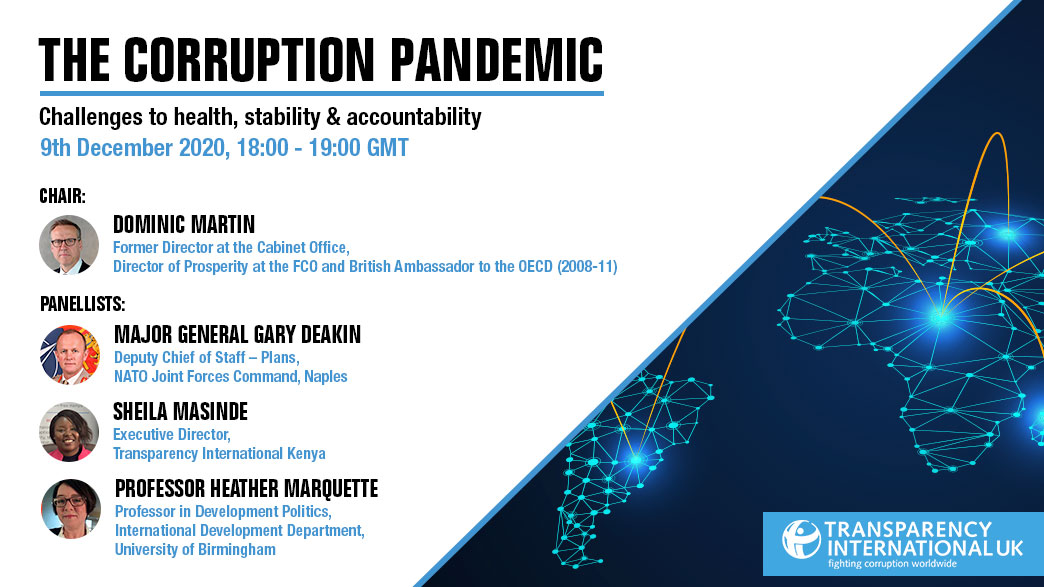
Date: International Anti-Corruption Day - Wednesday 9 December 2020
Time: 18:00 - 19:00 GMT
Chair: Dominic Martin (Former British Ambassador to the OECD, VP Government & Regulatory Affairs - Equinor)
Panellists:
- Major General Gary Deakin (Deputy Chief of Staff – Plans, NATO Joint Forces Command, Naples)
- Sheila Masinde (Executive Director of Transparency International Kenya)
- Professor Heather Marquette (Senior Research Fellow - Foreign, Commonwealth & Development Office)
Please join us on Wednesday 9th December for what will be a highly engaging evening.
Following registration, you will receive a link closer to the time of the panel which you use to join the event on the evening.
COVID-19 has created a challenging environment for all and without our donors, the work that Transparency International UK does in the fight against corruption would not be possible. Now - more than ever - we need your support and therefore a suggested donation of £5 is requested for attending this event (although any amount below or above this will be accepted). Thank you for your understanding.
The Annual Lecture - which usually happens on this day - has been postponed to March 2021.
The COVID-19 outbreak is not only a health crisis, but it also poses wider risks that may have repercussions on human and state security worldwide. Security is already deteriorating across the globe with millions of people vulnerable to conflicts and extremism.
While emergency legislation is hastily drafted and security sector actors are given prominent roles in supporting the management of the pandemic in countries across the world, it is crucial that the sector operates freely from corruption and is efficient and accountable to the population it is supposed to protect. In already fragile contexts, the health and economic crisis adds to the existing security challenges and puts additional burden on the security actors as well as those responsible to exercise democratic control on the sector.
Join us and our international experts and contribute to shape the discourse on security sector reform during and after the pandemic. At the end of the webinar there will be 20 minutes dedicated to the audience to ask questions, comment and reflect on these topics:
How can security sector reform continue during and after the pandemic?
What will be their challenges, priorities and opportunities?
Which role will anti-corruption play?